The Oxymoron of HIPPA #agreesharon

#agreesharon

Life is filled with so many interesting moments that I decided to create a weekly conversation starter around one of the more entertaining observations made during the previous week. Nothing too complicated — fun to see how people answer the question.

       Let me know what you think.

doctor patient talkingOxymoron : You are sharing a semi-private hospital room with someone.

Are HIPPA policies enforceable? How?

If you were the one in the 2nd hospital bed, would you leave the room whenever your roommate has a conversation with a medical professional?

Would you tell your family and friends about the roommate’s situation?


Customer Experience? Customer Engagement? Just do it!

To positively experience something OR to engage with something:

Are they any different?

Speaking to another marketing-industry friend recently, we joked about the overuse of the words: customer engagement and customer experience. The word engagement implies a deeper connection with the customer although the two of us agreed that every experience can make a lasting impact on ones’ choices and impressions.

  • Just do it.
  • Make me buy your product.
  • Make me use your service.
  • Make me smile.
  • Make me say “Thank you so much for making this happen for me.”

Here are a few simple examples.

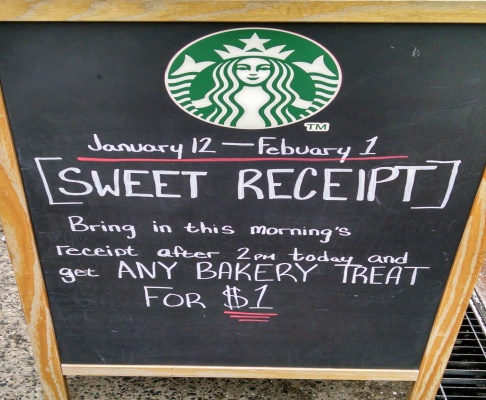
Walking back to the office one afternoon, I passed this Starbucks promotion. Looking to bring patrons back into the store for a mid-afternoon energy boost, the offer plays to one’s earlier purchase and reinforces Starbucks position as an all-day food source.  The price point for the treat equates to a chocolate bar. Having been in the store earlier in the day, you would know that the breakfast crowd paid 3-4 times that price. (And, to those snickering, let’s assume that the product freshness is intact.) starbucksMake me buy your product. 

Our family does not own a car and we become weekly rental customers during the summer. blue carFinding myself in Boston with a customer service problem involving a car picked up at the local Boston airport, I first called the Executive Member Customer Service center. Fail. Then I called our local rental site hoping that they would help. Fail. A direct FB message resolved the problem in one hour.
All four components of that experience made an impression on me.

Make me want to use your services.

This photo was taken at a marketing conference about a year ago. infographicThe artist was quick, creative and able to distill key points into a visually appropriate sequence. Looking at the info-graphic, like watching a twitter feed at a conference, served to reinforce my own learning while the visual format highlighted nuances in the presentation.

The multi-sensory experience made me smile. 

Walking around Manhattan during the bewitching hour of the mid-afternoon school dismissals, can be most entertaining. The other day, I literally stopped and turned around as I heard the voice of a very young child telling his mother that he splattered paint in class similar to the Jackson Pollack style of painting. It was not surprising when the child then went on to ask his mom about her email follow ups to confirm his weekly play dates.

As a mom, I was mighty impressed with the school’s ability to engage this very bright young child. I could almost hear the mom saying to herself:

“Thank you (school and teachers) for making this love of learning happen for my child.” 

Customer Experience. Customer Engagement. Whatever you call it. Just make it positively – memorable.


Originally posted for MENG on Feb 20. 2015: Customer Experience? Customer Engagement? Just Do It? http://ow.ly/JjYLb by @sharonlewisnyc [TODAY’S POST] #MENGonline #Marketing

I Went to School….#agreesharon


Life is filled with so many interesting moments that I decided to create a weekly conversation starter around one of the more entertaining observations made during the previous week. Nothing too complicated — fun to see how people answer the question.

       Let me know what you think.

Pre-School_GraduationImagine you are having one of those exploratory networking conversations with someone….both participants have a solid 20 years of professional work experience. One person kicks off the introduction by saying: Let me tell you a little bit about myself. I went to school….

Really! With twenty years of work experience…why would you begin the conversation with your school history? Keep in mind: (1) We do not share an alma mata and (2) You did not recently acquire a new credential in your industry or in a new industry.

Why would someone set the tone with this introductory statement?

Encouraging or Discouraging??

#agreesharon

Life is filled with so many interesting moments that I decided to create a weekly conversation starter around one of the more entertaining observations made during the previous week. Nothing too complicated — fun to see how people answer the question.

Let me know what you think.

With the Rio Olympic games in play, I found myself reading both current and historical articles about the event. Is the expression “You do not Win Silver….You Lose Gold” helpful to the competitive mindset or an insult to anyone other than he/she placing first?

medals


Have you made anyone feel that 2nd or 3rd place was not good enough? More importantly, did it provide any positive impact on the outcome?

Bubble in the Starched Shirt

#agreesharon

Life is filled with so many interesting moments that I decided to create a weekly conversation starter around one of the more entertaining observations made during the previous week. Nothing too complicated — fun to see how people answer the question.

Let me know what you think.

Walking by one of the fancier, established NYC hotels, I watched the starched shirt doormen assisting the well-dressed and casually-dressed hotel guests alike. The doormen juggled their assistance with the luggage, the hailing of the taxis and the requests for directions with never-ending smiles and cool composure.

So it is not surprising when I took a moment to pause because out of the corner of my eye, I noticed one of the clean cut doorman having a moment of rest —- and blowing a big bubble gum bubble covering up the bottom quarter of his face. Really??!!! Not quite the class act hoped for by the hotel management.

little boy blowing a bubble

And a good reminder that we all sometimes do things that are best done when not in the public spotlight.

Lesson reiterated……Someone is Always Looking. LOL

Leadership in a Crazy World

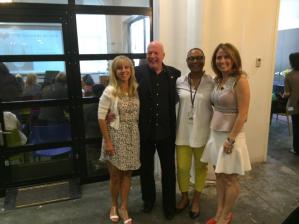
True to the theme of his new book, 64 shots : Leadership in a Crazy World, Kevin Roberts, leadership expert and Saatchi and Saatchi Chairman walked on stage and proceeded to punch out a series of anecdotes about leadership that were relevant and important for all generations. Moderating the conversation was Alexis Glick. The event, held on Wednesday June 15, was created and hosted by The Academi of Life and held at The Center for Social Innovation. Listening to the conversation, one could not help but sit on the edge of their seat, reflecting a similar stance Kevin took as he spoke about Leadership in a Crazy World.

So, why now? What is different about today’s leadership requirements?

Instant. Constant. Connected. Three words describing today environment where “the medium is the consumer” and measurements of success are correlated to the speed at which you learn, fail and fix. The military coined the term VUCA to describe a methodology that goes beyond strategy to real time situation management. In military terms, the acronym stands for Volatile, Uncertain, Complex and Ambiguous. For Roberts, the business leadership definition of VUCA is Vibrant, Unreal, Crazy (as in one person with one idea can change the world) and Astounding (as in speed). To both the military leaders and the business leaders, the message is blunt: Stop strategizing and assessing what actions to take. Be ready to do it NOW.

June 15 shirley moultonEveryone, Everyone, Everyone Needs a Plan
We are all quick to help and to advise others. However, critical to a leaders’ ability to lead others is the development of their own plan. Doing that means:
What is your one-word equity? Bruce Springsteen is The Boss. What is your essence?
When are you at your best? Variables might include time of day, environment, and available resources.
• What will you never do? Things are instant, constant and connected. What if something changes faster than planned; what was “reasonable” before may no longer be reasonable now.
What is your five-year dream? The next five years only happen once.
List three challenges that you will hold yourself accountable for over the next 12 months.

Kevin signed copies of his book while participants discussed their favorite anecdotes. For those who want to do it again, Alexis put the conversation on Periscope. Find it here. Join the conversation and let us know which leadership advice makes the most sense to your situation.

The Ongoing Conversation Needed with Performance Management

How does the performance management system tie to the needs of the business and how does individual performance get measured at the business dashboard level?

This question provided the big picture challenge addressed at the March 22 NYHRPS Forum facilitated by Dr. Anna Tavis. While previous practice sought to replicate the GE methodology, it is no longer the gold standard for management and leadership. Rather today’s leaders have become fast, lean machines that try something and test it on the go.

Intrigued by the case studies presented by Dr. Tavis, NYHRPS members wanted to continue the dialogue with specific action items that they could take back to their offices. And so, on May 3, NYHRPS Board Member Deb Seidman facilitated a Mastermind Group amongst a small group of members who had participated in the earlier Performance Management discussion. Participants brought case studies that reflected their current work. As a Mastermind group, questions were posed and advice was given, allowing the NYHRPS member to leave with an agenda that they could develop in their own organization.

Cultural Changes at the Grassroots Level will Impact the Success of a New Performance Appraisal System

While a wide range of questions came up during the discussion, case study conversations focused on three specific themes across organizations
• How does a small company take the best of the processes followed in a large enterprise while keeping its entrepreneurial spirit and nimbleness?
• How do you create of a culture of feedback at a grass-roots level?
• How do you create a common line of sight across organizational and personal missions…..so as to improve performance and achieve common goals?

With Forum participants representing both the for-profit and nonprofit sectors, Dr. Tavis asked:
• How do employee motivations differ in for-profit vs a non-profit entity?
• If nonprofits are mission driven, what does the concept of top down goal setting look like?
• Is a bottom up approach to goal setting more applicable to the non-profit where grass-roots programs and local area relationships are critical in meeting the organizational objectives?

One group considered what they would do if they were starting a performance system from a clean slate. Lessons learned from previous discussions provided the important anchors for building a new system or revising one in place.
• First and foremost end with a positive impact on the business strategy
• Focus on a simple method to identify good performers
• Create a culture of constructive feedback to accelerate and sustain high performance
• Get buy-in by incorporating the employee perspective
• Include customization for significant groups by division, generations, etc.

Another interesting moment in the conversation focused on finding champions to support those spearheading the organizational changes. Both the General Counsel and the Marketing teams were singled out as strong partners.
The Mastermind meeting structure was a new format for the Forum Committee. It brought nuances to the meeting that can only be discovered when individuals share the specifics of their individual stories in the spirit of trust, confidentiality and peer advisement. The Forum Committee thanks both Anna and Debbie for their contributions in facilitating these programs and to our participants who came prepared to share and to learn.

A recap from the March 22 discussion can be found here.

NYHRPS Break-Through Innovation Series of Forums provides a platform to discuss emerging issues among thought leaders, peers and HR decision makers in intimate settings limited to 15 participants and 2-3 experts.

Performance Management on Trial: To Keep or Not to Keep. Is that Really the Question?

Some 20 HR professionals gathered on the morning of March 22 to discuss Performance Management on Trial; an intimate Forum led by People and Strategy editor Anna Tavis. Participants ranged from senior executives in the corporate world to leaders in smaller entrepreneurial environments to those currently consulting to both of these businesses structures.

Are today’s performance evaluations enhancing both the employee experience and the business results?

As the group discussed today’s business environment and the current work being piloted by industry leaders such as Deloitte and Adobe, consensus was that the key question is not “Should we keep the performance management system”? Rather the first question today is “How does the performance management systems tie to the needs of the business and how does individual performance get measured at the business dashboard level?

The rise in collaborative teams used in the technology and service driven industries is a strong factor in this shift in focus, further ignited by social media, economic dynamics and the new cultural norms of conducting business. HR teams must be ready to support the business leaders with tools that can be readily created, piloted and adjusted.  checklist photoCookie cutter, off the shelf solutions, have gone by the way of the manual typewriter!

Hence today’s pioneering programs are designed to maximize the feedback that will motivate individuals to achieve their personal best within the organizational focus.  The science behind motivational behavior is playing a large role in today’s strategies. Designers are further doing everything possible to minimize the rater bias which historically played a negative role in the evaluation process.

What are the critical success factors emerging from today piloting PM systems?

Three of the key points that emerged from our pre-reads and our Forum dialogue depend on how you answer these questions:

  • How do you ensure a direct link between business objectives and individual contributions?
  • Is it possible to eliminate the inherent bias in the PM process?
  • What are the key success factors to allowing performance feedback to be continuous, collaborative and transparent?

Deloitte is piloting a program that addresses these objectives with a four-question performance snapshot *1. The snapshot looks to uncover how best to utilize the individual moving forward as opposed to a snapshot of the individuals’ past performance. Conceptually, Deloitte asks the leader to consider:

  • If it were my money, would I award this person the highest possible compensation increase and bonus?
  • Given what I know of this person’s performance, would I always want them on my team?
  • Is this person at risk for low performance (potentially jeopardizing service delivery?)
  • Is this person ready for a promotion today?

The Deloitte pilot is providing thoughtful input for the industry and impressive results for their own business.

Other organizations are considering rating-less systems while others are striving to create programs that recognize the necessary agility and forward thinking behaviors demanded from today’s top leaders. The group agreed that the annual rating system developed by GE in years gone by, is indeed a program that is no longer relevant.  The business is demanding real time feedback loops that provide coaching; the cookie cutter solution no longer works. The business needs and cultural norms demand customization and personalization; an approach that is surely in keeping with the way we manage every other part of our lives from shopping to investments to healthcare.

Where are we going?

As Anna Tavis summarized, we are living in a new reality. To be effective we need to start outside the box. Even if we have a roadmap to manage change and we follow the process to a successful end, we need to be prepared for disruptions anywhere along the way. Ask yourself, “What is the new reality?” More importantly, “What is your organization’s new reality?”

smart kidWhen once we sought to replicate the GE methodology, it is no longer the gold standard for management and leadership. Rather GE has become a fast, lean machine that tries something and tests it on the go. The new organization seeks to be agile and follows scrum and sprints (not waterfalls) as teams adjust their strategy in the middle of implementation.

Is your organization becoming a federation of businesses when once it was a hierarchy? As businesses customize products and services for their customers, they become uniquely different from the other businesses in their organization. When the variations become significant, and the hierarchy doesn’t work to improve performance, performance management evaluations need to be changed to meet new requirements. Such new requirements may be providing real-time performance data for individuals who come on and off multiple teams during the year, goals that change quarterly, work that gets done horizontally and evolving technology that takes new competencies to master and requires real-time feedback to learn.

In addition to these changing models in the business world,   the new reality is taking place amongst the military units stationed in Afghanistan. The old military model of handing off knowledge of new territories, cultural nuances and local game plans no longer work. The new reality is guerrilla warfare where one unit hands off intelligence to the next while on the run.

Closing Thoughts

Change management roadmaps are helpful in keeping organizations up to date with the shifting economy…. But be prepared for disruptions and agile shifts or you will miss the market, the financial opportunity, or the customer’s needs.

*1 Harvard Business Review. April 2015. Reinventing Performance Management.  Ashley Goodall


Future of Marketing: Collisions and Complexities

The Future of Marketing Summit 2015: Collisions and Complexity #FTMarketing is always a treat to attend. While conference attendance continues to drop these days, the live conferences allow us to share our real time views in more than 140 characters, giving some additional color to the speaker comments.

The conference explored relevance and personalization —objectives that marketers always strive to achieve — regardless of the available technology and in spite of the available technology.

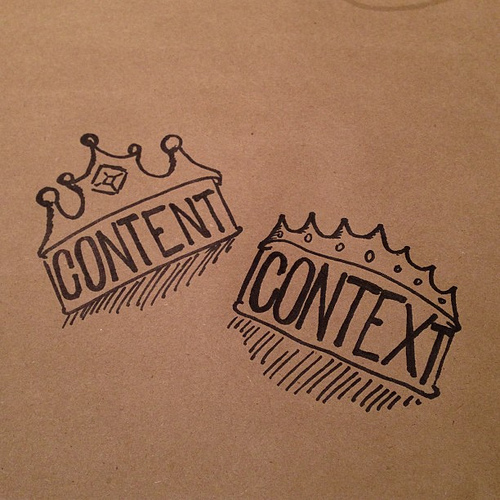
“Content is king. Context is queen and she wears the pants.” 

Big data and the balance of personalized messaging, limited budgets and the creep factor caused by revealing the knowledge of too much individual data, continue to be a dominant subject on everybody’s mind. Ad-blocking is a relevant piece of the conversation as it impacts so many of the content development and customization strategies that we all are exploring.

content and contextWith so much free content available, what motivates someone to share the information that allows us/them to customize their stream of news? The answer lies in the value proposition. The importance of which is not new; the newness is in the never-ending expansion of resources that we can use to meet our needs.

Hence, if I can get the information elsewhere, I will get it wherever it is easiest and most obviously synergistic.

  • Exemplifying this example was Seth Farbman, CMO at Spotify. Consumer access to music at little to no cost delivers huge exposure for the artist. For those artists who do not have the marketing and label support, Spotify sees themselves as an avenue for artist exposure. Their goal is to build music fans. The majority of their users do not pay fees. However, the Spotify service is not free; it is advertising supported. Hence what happens to this business model when users go incognito?

Knowing that “Content is king. Context is queen and she wears the pants.” What can the marketer do to ensure the right experience for the individual customer?  Simultaneously, what can be done to maintain advertising dollar supports? Maintaining a robust exchange of information is paramount.

  • Businesses that are using Virtual Reality (VR) provided a good example of creating customer relevancy. In fact, one of the panelists shared his own story; it involved a dislike for camping activities which ended in the booking of a camping trip after a VR experience. Sounds like the adage: Try it. You’ll like it. Virtual Reality brings us closer to the experience than any copy deck or photo montage could achieve.

Storytelling: A Strategic Business Tool

8591351239_24bcb987df_nAnd, when VR is not possible, we know that a well-delivered story format is a readily affordable tactic to initiating an immersive brand experience. In the panel titled “Shifting the Brand Strategy in the Age of Empowered Consumer”, one message was unanimous: Brands can no longer speak to the customer. Rather, brands must speak with the customer. Be it a consumer or a  B2B transaction, the human being will make a decision and individuals want to buy things that reflect smart decisions and which make them feel like they are adding value to the situation.

When is yes a maybe? Marketers are still figuring this out.

Unraveling what the customer wants will continue to be an ongoing riddle. The true psycho-graphics behind one’s behavior are rarely available on an individual basis and just because someone looks at a website does not mean they want to use or buy the product….a challenge with programmatic marketing.

As marketers, we want to test everything to see how we can better create a dialogue with our customer groups. However, social media is still being challenged to prove the consistency of the measurable impacts that the tactics generate for a campaign.

  • There was an audible chuckle in the audience when Roel de Vries, Global Head of Marketing and Brand Strategy at Nissan Motor Company spoke to the “hobby-ism of doing things. If I have to sell x million cars, is 10,000 hits good enough to get me there?” And, hence, we must again balance testing opportunities with scale impact and the budget allocation.

The Basic Human Need for Emotional Resonance

As technology continues to alter the way we consume data for our decisions, there was chatter amongst the room for another proven behavior: The continued need for emotional resonance. No matter how technological our society has become, in the end, we are individuals with numerous personas that are all actively in play at any given time.

Reminding us of this basic human nature was the five step ecosystem that individuals use to make decisions. The buzz words have changed over time however the concepts remain intact. The five step ecosystem is: brain photo

  • Notice: Get noticed. Create awareness.
  • Curiosity: Generate interest.
  • Interaction: Offer an array of opportunities for interaction and the query for more information. Engage the customer/prospect in a dialogue that makes the impact of this product in their lives real.
  • Reinforcement: Create on-going reinforcement of the purchase decision.
  • Evangelize: With the ultimate goal of turning the customer into an evangelist your product

Some things do not change; they get modified and fine-tuned to reflect the modern-age tools.

Relevance, personalization and service excellence continue to be the critical success factors in establishing long term relationships.

If you found any of the subjects in this post to be of interest to you, please get in touch and lets continue the conversation.

Thank you to the Marketing Executives Networking Group MENG for my ticket. to this event.

Generational Diversity in the Workplace; Myths and Realities

Time Flies. Did I Act that way at the age of 22—– YES, you did!

Human tendency looks at each new generation and sees radically different behaviors than those which they themselves expressed. Wharton Business School Professor Peter Cappelli   says that “many managers overemphasize the generational differences, in part, because they forget what it was like to be young themselves.” Is this a true or cynical comment?”

A multi-generational workplace is not a new phenomenon. So what, if anything, is different today?

NYHRPS Forum participants gathered to explore this question on the morning of July 14 when they gathered, under the facilitation of Bo Young Lee, Global Diversity & Inclusion Leader for Marsh LLC.

Across the generations, we hold many common human values and goals. Yet, we view others through a lens that says ‘what experiences have we shared” and in turn, we apply judgments that are often broad brushed and untrue when we see behaviors that appear unfamiliar to us. As a group, the NYHRPS participants agreed that regardless of the common values and goals shared by the five generations living in the 21st Century, the digital natives, born after 1980, is behaviorally different. Technology has allowed them to connect in ways never before experienced and to work fluidly across borders and boundaries to gain access to information in real time to make decisions. techno millenials

Rather than focusing on the wonderful impacts of technology into their/our lives, we focus on the behavioral differences that this younger generation exhibits. Perhaps, we need to take a breath and say “Enough!”

What should HR leaders be doing to create a workplace that supports open communications and understanding across all ages, and builds on the unique values and strengths of each generation?

Bringing diverse groups of people together is not the same as making the individuals feel included. Forum members were asked to consider the way traditional Diversity programs address, or fail to address, the multi-dimensional backgrounds of the individual. Progressive teams are using an intersectional approach which demands that we shift the conversation away from distinct labels and categories to a broader view of the person.

creative-desk-pens-school-mediumImpact: Workforce estimates by 2020 show millennials comprising over 50% of the population, with a profile that includes nearly 40 percent non-white race or ethnicity. Traditional labels no longer apply, and many millennials frown on labeling anyway. (Pew Research in the Deloitte University Press 

Radical Transparency, a concept where there are zero hidden agendas and information is made available to everyone, has become a norm for Millennials.

Impact: With unprecedented access to information, and growing up in a networked world where you can establish a relationship without ever meeting someone, millennials take an approach to trust that differs from previous generations.

Millennials are radically transparent because they want to create a level playing field and trust people intrinsically. They embrace an egalitarian approach to work. Likewise, with this plethora of information available to them, they want to be heard and they want their opinions to be considered — in spite of the years of experience they have yet to live.

Command and Control Organizational Structure vs. Collaborative Structure: Today’s hierarchical pyramid structures are less likely to work for the senior leaders of 2030. How should HR leaders be redefining the way we develop tomorrows’ leaders, given the increasingly diverse global environment?

work structureImpact: Millennials have been brought up in a structured world with hyper scheduled programming. However, within that construct of scheduling and structure, the millennials’ schedule was based on their individual dreams and aspirations. Contrast this with boomers who were raised with a pre-determined structure. (Think daily print newspapers vs real time, self-defined news feeds.)

Does one structure have more accountability? Yes and No. Understanding the specific business line is important as highly regulated industries must include a series of imposed operational requirements to remain in business. That being said, many of today’s most successful initiatives have been exponentially enhanced through collaborative environments where intrinsic motivations, as compared to imposed motivations, lead the business process.

O tempora o mores“, an age old colloquialism from Cicero criticizes present day attitudes and trends. As leaders, we will do ourselves and those from other generation’s justice with an attitude that displays more flexibility toward those we work with. Let patience and learning prevail.