Category Archives: Communicating Every Day

Forgetful Brain Freeze

#agreesharon
Life is filled with so many interesting moments that I decided to create a weekly conversation starter around one of the more entertaining observations made during the previous week. Nothing too complicated — fun to see how people answer the question.
Let me know what you think.
brain

Millennials call it forgetfulness or a memory lapse; Boomers call it a senior moment or a brain freeze. Source: AARP Research When boomers use these terms, are they subconsciously reinforcing out of date perceptions?

If you are a boomer reading this….use the word forgetful, the next time you just can’t put your finger on what it is you want to say!


A Cargo Perspective

#agreesharon

Life is filled with so many interesting moments that I decided to create a weekly conversation starter around one of the more entertaining observations made during the previous week. Nothing too complicated — fun to see how people answer the question.

Let me know what you think.

People have different perspectives on how to keep track of  their precious cargo. Imagine the following two scenarios which took place on a major midtown Manhattan avenue.

  • First, I see a young fashionably-dressed woman talking on her cell phone while a toddler waddles behind her. She is walking somewhat sideways so as to keep an eye on the child, however there is a distance between the two of them that measures somewhere between one-third and one-half city block.ducks walking
  • A few minutes later, I see a young man walking down the street. He looks like a sweaty tightrope walker. He is balancing some 6 (very large) trays of eggs in his arms.

Doesn’t it seem that the transportation method should have been switched up in these scenarios?

In the described situation, would you have said something to the young woman? Would you have offered to help the young man?

OR, would you have power-walked past both of them?

Let Me See What You Got

#agreesharon
Life is filled with so many interesting moments that I decided to create a weekly conversation starter around one of the more entertaining observations made during the previous week. Nothing too complicated — fun to see how people answer the question.
Let me know what you think.

The power of suggestion is all around us.
In just a few city blocks, I took note of how many storefronts ensure that their services are out-front and easily visible for all to see. Playing with animals, casual dining or sit-down tablecloth dining – the experience is as much about the product as it is the ability to share it with others.doggie care

magnolia bakery

starbucksWhen was the last time you grabbed a cup of coffee or a snack because you walked by the storefront window, saw it and thought “Yeah, I would like one of those!”


The power of suggestion is all around us. What will you spontaneously pick up later today?

Customer Experience? Customer Engagement? Just do it!

To positively experience something OR to engage with something:

Are they any different?

Speaking to another marketing-industry friend recently, we joked about the overuse of the words: customer engagement and customer experience. The word engagement implies a deeper connection with the customer although the two of us agreed that every experience can make a lasting impact on ones’ choices and impressions.

  • Just do it.
  • Make me buy your product.
  • Make me use your service.
  • Make me smile.
  • Make me say “Thank you so much for making this happen for me.”

Here are a few simple examples.

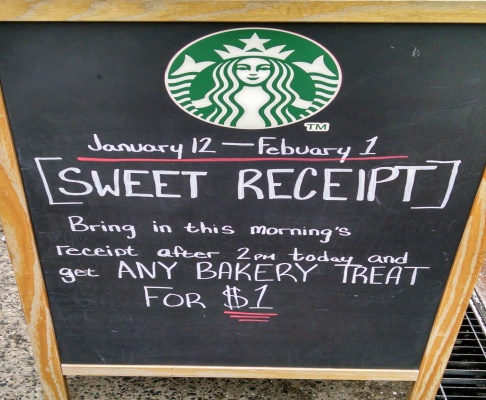
Walking back to the office one afternoon, I passed this Starbucks promotion. Looking to bring patrons back into the store for a mid-afternoon energy boost, the offer plays to one’s earlier purchase and reinforces Starbucks position as an all-day food source.  The price point for the treat equates to a chocolate bar. Having been in the store earlier in the day, you would know that the breakfast crowd paid 3-4 times that price. (And, to those snickering, let’s assume that the product freshness is intact.) starbucksMake me buy your product. 

Our family does not own a car and we become weekly rental customers during the summer. blue carFinding myself in Boston with a customer service problem involving a car picked up at the local Boston airport, I first called the Executive Member Customer Service center. Fail. Then I called our local rental site hoping that they would help. Fail. A direct FB message resolved the problem in one hour.
All four components of that experience made an impression on me.

Make me want to use your services.

This photo was taken at a marketing conference about a year ago. infographicThe artist was quick, creative and able to distill key points into a visually appropriate sequence. Looking at the info-graphic, like watching a twitter feed at a conference, served to reinforce my own learning while the visual format highlighted nuances in the presentation.

The multi-sensory experience made me smile. 

Walking around Manhattan during the bewitching hour of the mid-afternoon school dismissals, can be most entertaining. The other day, I literally stopped and turned around as I heard the voice of a very young child telling his mother that he splattered paint in class similar to the Jackson Pollack style of painting. It was not surprising when the child then went on to ask his mom about her email follow ups to confirm his weekly play dates.

As a mom, I was mighty impressed with the school’s ability to engage this very bright young child. I could almost hear the mom saying to herself:

“Thank you (school and teachers) for making this love of learning happen for my child.” 

Customer Experience. Customer Engagement. Whatever you call it. Just make it positively – memorable.


Originally posted for MENG on Feb 20. 2015: Customer Experience? Customer Engagement? Just Do It? http://ow.ly/JjYLb by @sharonlewisnyc [TODAY’S POST] #MENGonline #Marketing

I Went to School….#agreesharon


Life is filled with so many interesting moments that I decided to create a weekly conversation starter around one of the more entertaining observations made during the previous week. Nothing too complicated — fun to see how people answer the question.

       Let me know what you think.

Pre-School_GraduationImagine you are having one of those exploratory networking conversations with someone….both participants have a solid 20 years of professional work experience. One person kicks off the introduction by saying: Let me tell you a little bit about myself. I went to school….

Really! With twenty years of work experience…why would you begin the conversation with your school history? Keep in mind: (1) We do not share an alma mata and (2) You did not recently acquire a new credential in your industry or in a new industry.

Why would someone set the tone with this introductory statement?

Encouraging or Discouraging??

#agreesharon

Life is filled with so many interesting moments that I decided to create a weekly conversation starter around one of the more entertaining observations made during the previous week. Nothing too complicated — fun to see how people answer the question.

Let me know what you think.

With the Rio Olympic games in play, I found myself reading both current and historical articles about the event. Is the expression “You do not Win Silver….You Lose Gold” helpful to the competitive mindset or an insult to anyone other than he/she placing first?

medals


Have you made anyone feel that 2nd or 3rd place was not good enough? More importantly, did it provide any positive impact on the outcome?

Bubble in the Starched Shirt

#agreesharon

Life is filled with so many interesting moments that I decided to create a weekly conversation starter around one of the more entertaining observations made during the previous week. Nothing too complicated — fun to see how people answer the question.

Let me know what you think.

Walking by one of the fancier, established NYC hotels, I watched the starched shirt doormen assisting the well-dressed and casually-dressed hotel guests alike. The doormen juggled their assistance with the luggage, the hailing of the taxis and the requests for directions with never-ending smiles and cool composure.

So it is not surprising when I took a moment to pause because out of the corner of my eye, I noticed one of the clean cut doorman having a moment of rest —- and blowing a big bubble gum bubble covering up the bottom quarter of his face. Really??!!! Not quite the class act hoped for by the hotel management.

little boy blowing a bubble

And a good reminder that we all sometimes do things that are best done when not in the public spotlight.

Lesson reiterated……Someone is Always Looking. LOL

Generational Diversity in the Workplace; Myths and Realities

Time Flies. Did I Act that way at the age of 22—– YES, you did!

Human tendency looks at each new generation and sees radically different behaviors than those which they themselves expressed. Wharton Business School Professor Peter Cappelli   says that “many managers overemphasize the generational differences, in part, because they forget what it was like to be young themselves.” Is this a true or cynical comment?”

A multi-generational workplace is not a new phenomenon. So what, if anything, is different today?

NYHRPS Forum participants gathered to explore this question on the morning of July 14 when they gathered, under the facilitation of Bo Young Lee, Global Diversity & Inclusion Leader for Marsh LLC.

Across the generations, we hold many common human values and goals. Yet, we view others through a lens that says ‘what experiences have we shared” and in turn, we apply judgments that are often broad brushed and untrue when we see behaviors that appear unfamiliar to us. As a group, the NYHRPS participants agreed that regardless of the common values and goals shared by the five generations living in the 21st Century, the digital natives, born after 1980, is behaviorally different. Technology has allowed them to connect in ways never before experienced and to work fluidly across borders and boundaries to gain access to information in real time to make decisions. techno millenials

Rather than focusing on the wonderful impacts of technology into their/our lives, we focus on the behavioral differences that this younger generation exhibits. Perhaps, we need to take a breath and say “Enough!”

What should HR leaders be doing to create a workplace that supports open communications and understanding across all ages, and builds on the unique values and strengths of each generation?

Bringing diverse groups of people together is not the same as making the individuals feel included. Forum members were asked to consider the way traditional Diversity programs address, or fail to address, the multi-dimensional backgrounds of the individual. Progressive teams are using an intersectional approach which demands that we shift the conversation away from distinct labels and categories to a broader view of the person.

creative-desk-pens-school-mediumImpact: Workforce estimates by 2020 show millennials comprising over 50% of the population, with a profile that includes nearly 40 percent non-white race or ethnicity. Traditional labels no longer apply, and many millennials frown on labeling anyway. (Pew Research in the Deloitte University Press 

Radical Transparency, a concept where there are zero hidden agendas and information is made available to everyone, has become a norm for Millennials.

Impact: With unprecedented access to information, and growing up in a networked world where you can establish a relationship without ever meeting someone, millennials take an approach to trust that differs from previous generations.

Millennials are radically transparent because they want to create a level playing field and trust people intrinsically. They embrace an egalitarian approach to work. Likewise, with this plethora of information available to them, they want to be heard and they want their opinions to be considered — in spite of the years of experience they have yet to live.

Command and Control Organizational Structure vs. Collaborative Structure: Today’s hierarchical pyramid structures are less likely to work for the senior leaders of 2030. How should HR leaders be redefining the way we develop tomorrows’ leaders, given the increasingly diverse global environment?

work structureImpact: Millennials have been brought up in a structured world with hyper scheduled programming. However, within that construct of scheduling and structure, the millennials’ schedule was based on their individual dreams and aspirations. Contrast this with boomers who were raised with a pre-determined structure. (Think daily print newspapers vs real time, self-defined news feeds.)

Does one structure have more accountability? Yes and No. Understanding the specific business line is important as highly regulated industries must include a series of imposed operational requirements to remain in business. That being said, many of today’s most successful initiatives have been exponentially enhanced through collaborative environments where intrinsic motivations, as compared to imposed motivations, lead the business process.

O tempora o mores“, an age old colloquialism from Cicero criticizes present day attitudes and trends. As leaders, we will do ourselves and those from other generation’s justice with an attitude that displays more flexibility toward those we work with. Let patience and learning prevail.


Get Real! Purpose + Calling + Balance

The New York Human Resources People and Strategy Group recently hosted an insightful presentation featuring social entrepreneur Aaron Hurst.

In this interactive and provocative session, Aaron presented his concept of a “Purpose Economy”, in which purpose will replace information as the dominant economic driver. Embedded in this new definition of purpose are the concepts of:
• Choice
• Calling
• Self-awareness

The desire for purpose, calling or self-fulfillment is not new. However in today’s society which allows 24/7 connectivity, availability and choice…… the boundaries between our work and personal lives is often non-existent. The concept of work: life balance has become a concept of work: life integration. The premise of seeing one’s act of labor as fulfilling and satisfying —regardless of the role one plays in the world of work—- provides the consistency that allows us to thrive in everything that we do.

Research has shown significant levels of employee disengagement and frustration. Further studies surmise that the disengaged workforce is less productive, less dependable, and less loyal to the work-team. Infusing the purpose approach into every aspect of our lives becomes critical. The concept starts with an attitude. Individually, we create purpose by choosing how to approach a job vs. only looking at the actual content of the job that we are doing.

Some industry articles attribute this shift in philosophy to the millennial; I think the fundamentals of the purpose concept have been percolating for a very long time. Our aging society, sandwich generations and millennial attitudes have allowed these frustrations to be channeled in a positive direction. As a member of the Boomer generation, I grappled with work: life balance as I entered my parenting years and was an active participant in remote work schedules, freelance contracts and career off-ramps. The Purpose Economy addresses the personal interests and demands of individuals by “allowing us to publicly balance our multiple obligations”.
balancing act photo
How can we combine passion and expertise consistency in our lives –vs. – looking to our volunteer work and hobbies to fill in these gaps? Does each of us have the ability to work with purpose and to live with purpose? Is this a learned activity? Will this increased awareness obligate everyone (the employers, the employees, the clients and the providers) to realize that work: life integration is reasonable and attainable? The answer is a definite YES!

Aaron shared four recommendations with the audience that can be viewed as opportunities for both the individual as well as the collective employer/work environment to support purpose-oriented activities. They are:

1. Develop individual self-awareness. As an employer, strive to assist your employees in building their self-awareness.
• Those who demonstrate calling in their daily lives see their actions as being bigger than them. They are motivated by the ability to impact others in positive ways. They are confident in their actions being consistent with their driving emotions.

2. Tailor your work to reflect the purpose(s) that motivate you. As an employer, allow the employee to tailor their work to boost their own sense of purpose.
• Doing this involves the deepening of relationships, defining opportunities for growth and maximizing the impact that someone can make in a situation.

3. Connect your personal purpose with your organizational purpose. As an employer, allow your employees to understand the impact of their labor on the bigger picture.
• People who behave from a position of purpose or calling see their efforts as providing positive growth. The power of continuous learning is important to all of us.

4. Celebrate and connect with others who share your approach to life. As an employer, create opportunities where individuals who share a common perspective can learn and grow together (This does not mean that they work together, Rather that they serve as motivators for each other.)
• I note that this example was given within the context of bringing people together who tested with similar purpose profiles. People with different functionalities and backgrounds were able to gain a new perspective on subjects that they had no understanding— when the sharing was made with someone else who shared a similar purpose-perspective. As a marketer, this reiterates the importance of the emotional connections that we create within all aspects of our lives.

May the spirit of purpose guide us successfully into a fulfilling 2015!great miinds quote

Tame The Elephant in the Room

You know that feeling you get in your gut when a difficult subject needs to be addressed and you suddenly become the world’s master of procrastination.  Is there an elephant in the room?  What do you do if:

  • The customer service center was unable to handle the volume of inbound leads generated by your Facebook campaign.
  • You hit “reply all” on a conversation which included sensitive subject matter intended only for “reply to sender.”
  • An entire electronic file appears to be missing and the intern is still working on updating the documents.
  • Cash is missing or you realize that someone chipped the heirloom figurine and neglected to tell you.
  • Your toddler, who is in the middle of toilet training, decides to show off their new skills in the toilet remodeling department of Home Depot (Just saw this LOL scene on TV).

No matter how much training you have in mediation or facilitation, these sorts of situations are rarely viewed as light conversation.  Unaddressed, these issues foster confusion and make everyone distracted, preoccupied, and sometimes fearful.  All of these emotions waste valuable time and hamper productivity.

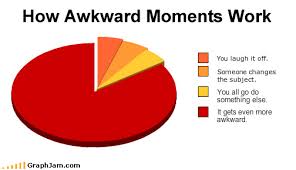
Wikipedia describes the elephant in the room phrase as “an obvious truth that is either being ignored or going un-addressed…an obvious problem or risk no one wants to discuss…” awkward moment image

Five Steps to Managing the “Elephant in the Room”

Recognizing the elephant in the room is an important first step.  The real finesse, however, comes in acknowledging  the elephant in a manner that allows everyone to feel comfortable enough to participate in the discussion and then to move past it.  Let’s take a look at some of the ways that we can tame the proverbial “elephant in the room:”

  1. Open up the discussion by expressing the issue and inviting input from others.  To do this effectively necessitates that you share your views with little or no emotion.  Why?  Because emotions are contagious and at this point, you are looking to ask others to share.
  2. Asking others to share their viewpoint displays consideration for their perspective.  Stop and listen —really listen—to what they say.  Acknowledge their input and demonstrate a sincere interest in their comments.  Creating an environment where someone feels like they can share allows you to discuss a potentially “forbidden” subject and sets the tone for continued dialogue.  As the dialogue continues, you collect more information that can be used for a reality check.
  3. Do a reality check:  Is this really an elephant or can we resolve this with less drama?  Your attitude on this may set the tone for others and alleviate stress or awkwardness.  Honesty expressed in a calm and thoughtful manner can help to disarm the elephant.
  4. Be honest, direct and convey confidence.  A difficult issue becomes an elephant in the room when it is ignored despite everyone being aware of it.  By naming what others may be avoiding, you will transform the elephant into an obstacle—obstacles are far less overwhelming for the psyche to handle and move off of.
  5. Move forward:  Thank everyone for their inputs.   Summarize the next steps.  Ask others to concur with your summary.  Where possible, ask others to take on a responsibility that increases the likelihood of maintaining harmony.

Deep breath.  You can tame the elephant and move forward.

original post : “You, too, Can Tame the Elephant in the Room” http://ow.ly/qJHb8 by@sharonlewisnyc [TODAY’S POST] #MENGonline #Marketing #Leadership