
Location. Location. Environment. Environment

Location. Location. Location. This has long-been the mantra in the real estate industry. I propose an extension of this mantra which says: Location. Location. Environment. Environment. The environment that you set up for your work, home, study and communications is as important as the physical location.

I recently learned of a wonderful woman who was looking to launch a think-tank for entrepreneurial start-ups. Her twist on the concept was great and I looked forward to getting the announcement details for the kick-off event. Her meet-up announcement drew a strong response. So why did so very few people show up to the meeting? The location, while conveniently located and free to the facilitator—-was to be held on the second floor conference room of a funeral parlor. Location and environment need to work together.

A recent retiree was excited to start taking classes at her local community center. She read the website and the catalog in detail and chose a selection of programs. Her first day of class, she noticed a sign on the building that she never took note of previously; it read: “Senior Center”. The woman felt horrible and while she knew that both the class and the other class participants were young and vibrant, she gets a knot in her stomach every time she enters the building and sees the words “senior center”. Nuances in one’s environment can make all the difference.

Years ago a decorator told me how they were asked to create a working space for a young student with ADD, poor grades and a frustrated attitude toward his school work. As the story was told, the decorator’s chest popped outward and his shoulders squared back—“I designed a working area for that student”, he said which “took that young man’s grades up to B+/A-. That marked an entirely different type of reward for the decorator who normally created beautiful entertaining spaces.

What do you do every day to create an environment that is creative to your own work and the comfort level of others? Here are a few more examples that I have found recently.

When you speak to your doctor, do they stand or sit so as to meet you at your eye level? They should; it creates an entirely different environment for your conversation.

When you meet someone in their offices, do they bring the conversation to the small work table in their office or move their chair around their desk so as to sit next to you while speaking? That desk creates an informal barrier.

Whenever I am in the elevator of an office building, I always look out into the offices of each floor that the elevator makes a stop. Today I watched as three people got out on the same floor and each employee passing by the reception desk took a piece of the fresh fruit sitting in the bowl on the reception table. What a nice way to tell someone: Good Morning; Take good care of yourself!.

And least, we forget the lighting, the flowers, the candles and the music which so distinctly add dimension to our environment.

Location. Location. Environment. Environment. Both are key criteria to making you, your family and your business team comfortable.
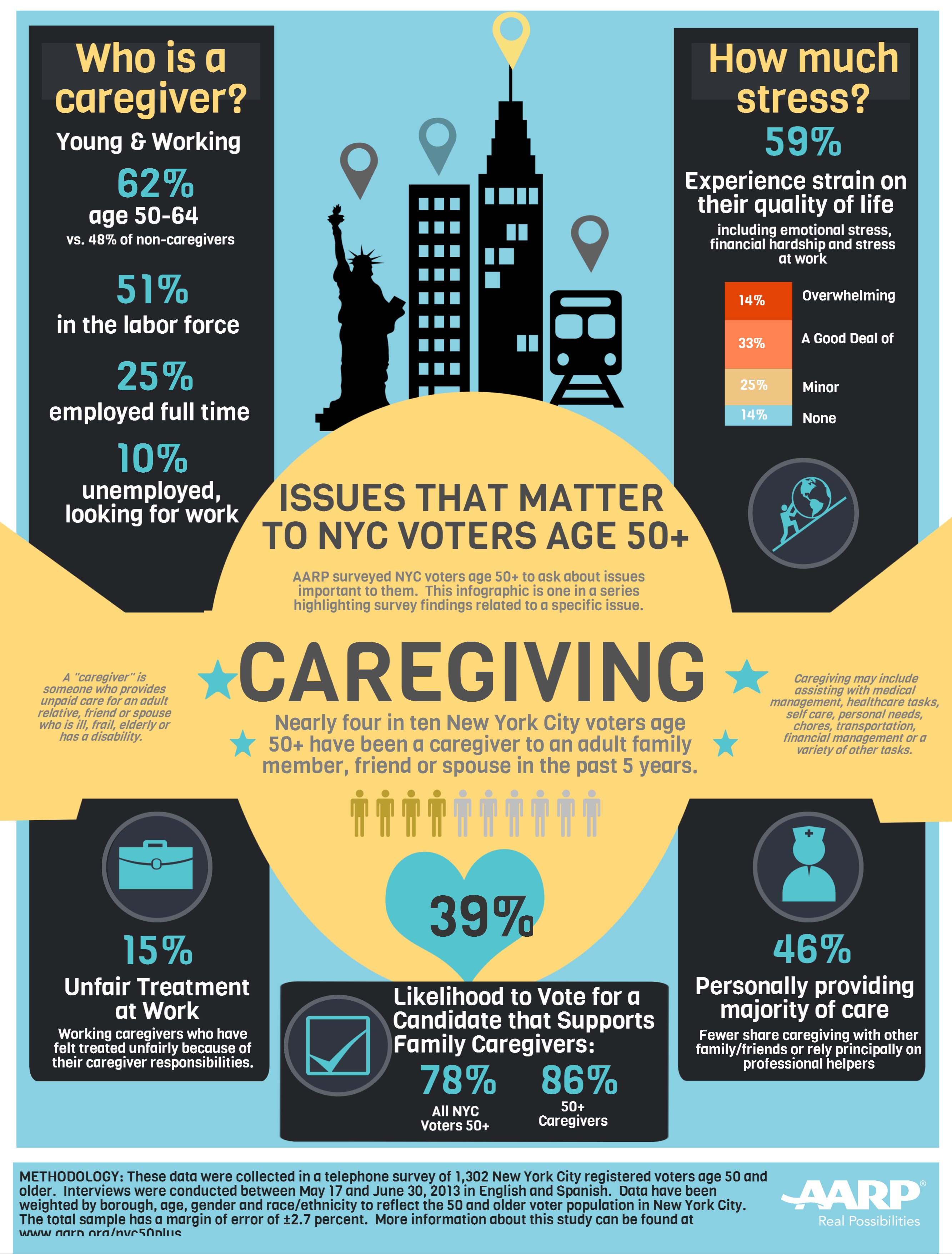
Issues that Matter to NYC Voters Age 50+

Image

Via a Sept 30 2013 AARPNY Press Release: A new AARP survey takes a harder look at the issues facing caregivers in New York City and what they want who they vote for to do about it.

When it comes to family caregivers getting the support they need, New York State lags behind the rest of the nation, ranking dead last according to the State Long-Term Services and Supports Scorecard (http://bit.ly/1bvxRZ8). AARP says that lack of support is causing serious pressure on New York caregivers.

“Providing crucial care for older relatives is a reality for many New Yorkers and it’s also a point of major struggle as they look for resources and support,” said Beth Finkel, State Director for AARP in New York State.  “Caregivers in New York City are strained and stressed, and they are looking for help.”

AARP has been working to bring the issue to the attention of the Mayoral and City Council candidates in NYC, holding a series of debates, voter engagement efforts, and grassroots activities. AARP members are expected to account for half of all votes cast in the NYC General Elections.  While AARP does not endorse candidates, have a PAC, or give money to campaigns or political parties, the non-partisan membership organization does provide straight-forward information on the issues to 50-plus voters, the media and the general public.

Over the last several months, AARP has held caregiver listening sessions throughout New York State, pulling together policy leaders and stakeholders to hear about the struggles and issues facing family caregivers. AARP will be compiling a report based on the sessions along with a set of policy recommendations within the next month.

Follow AARP on on Twitter: @AARPNY and Facebook: AARP New York

Tweets My Own

Reflections on a Mayoral Forum

Reflections on a NYC Mayoral Forum:

AARP NYC launched a new Go Local campaign on August 6 which included a mayoral forum targeting the city’s 50-plus voter community. The room was abuzz with 1,000 attendees, 50 media outlets and 10 of the 11 NYC mayoral candidates. What a happening for AARPNY!

These events often take on a life of their own and when one mayoral candidate called another candidate “Grandpa”, the press officially had another twist on the story to report. And they did!

  • The Grandpa comment was described as “being made in a room filled with senior citizens”.
  • And, AARP was further defined as the organization behind “this senior citizen event”.
  • The candidates represented referenced their views on “helping those senior citizens in the room”.

What is a senior citizen, I ask? Age or attitude?

Data from the U.S. Census Bureau, quoted in an NTAR Leadership Center Study,  suggest that, by 2016, one-third of the total U.S. workforce will be age 50 or older, and will increase to 115 million by 2020 (U.S. Census Bureau, 2010)

Supporting every possible product or service line, the advertisers are working hard to make “70 the new 50” and likewise convince us all…that the best is yet to come. The reality is that the words “senior citizen” still has a negative connotation in our society: retiree, old-timer, fuddy-duddy and such. When was the last time you heard someone refer to a senior citizen as a thought leader or an innovator?

So as someone on the very edge of the baby boomer tail, I found myself bewildered as the candidates called the AARP membership of 50 – plus year olds senior citizens. And, I found myself laughing at the hypocrisy of the whole situation. When you looked around the room in real-time, it did not appear that anyone in the room had taken a day off from the social adult day-care programs.

With 7 of the 11 candidates aged 50 plus, do these candidates consider themselves senior citizens? They kept referring to the AARP members as senior citizens. Does NYC want to elect a senior citizen to run their city?

A 2012 Harvard Business Review Blog called: How Companies Must Adapt for an Aging Workforce does a nice job summarizing the situation:

  • First, attitudes need to change; Businesses and people alike need to practice what they claim to support.
  • Older workers are often seen as a burden, with younger candidates preferred in recruitment decisions. In economies where knowledge rules, the experience of older workers grows in value.
  • Older people are seen as fragile. Yes, many are. Others are not. At some point, the 80:20 rule kicks in and with the population life expectancies ever increasing, the age where the disproportionate expenses truly kick into place is increasing as well.

So everybody, please, stop calling those who are aged 50-plus senior citizens. And for the Mayoral Candidates: Recognize the new reality and explain how you will address the situations of those:

  • Who are 50-plus and experiencing age discrimination in the workplace
  • Who are dependent on social services and unable to earn an income any longer
  • Who are unable to retire as planned because the costs of living are rising
  • Who are uncertain how they will afford to age gracefully in place, in NYC, because of ever-increasing costs for housing and utility bills, issues of crime and safety and more!

Let’s get focused and back on track. NYC is one of the greatest cities on this earth. What makes the candidates qualified to sit at the head of the table running a $70 Billion budget?

BTW: For a detailed review of the issues NYC 50-plus voters are talking about around their kitchen table, check out:  http://www.aarp.org/NYC50plus

Guest Blogger @AARPNY. Tweets all mine

Slow Down to Accelerate

Our family lived in Toronto for 9 years. For the first 6 months, I was so pleased when I would call someone and by the time that I finished saying “Hi so-and-so” they were already responding with “Hi Sharon”. Caller ID was not the vogue yet so I felt so special that they recognized me so quickly. How did you know it was me so fast?” I would ask. The answer was always “your accent”. “What accent, I sound just like you do” Hmmmmm

Two other times in my life I have been told that my speech is distinctive. The first significant time was also in Canada. On the launch team for a first of kind product in the country, it was an exciting time and one where my USA experience was often referenced. In one particular meeting with the SVP of the division, I was presenting my ideas on the qualitative and quantitative research strategies that I was responsible for spearheading. I was SO excited. My hands were moving, my lips were grinning ear to ear and I was excited to be telling the story and responding to the questions. At the end of the meeting, the SVP pulls me aside and says slowly and seriously:

  • Your ideas are fabulous. You understand our objectives and have a great handle on how to approach the business
  • Your energy is contagious
  • However when you speak so quickly, I can barely keep up with you.

With a big grin on his face, he said: “If I am digesting the details to put your second suggestion into place and find myself coming out of this mind-set to hear you speaking about the fourth suggestion, we both loose. I am the big guy here. I cannot admit that I missed a step and need you to go back and explain something to me again. LOL. Seriously, please speak slowly. Make sure that I am with you every three-to-four sentences. In whatever way you must, get the input of the audience and the senior most member of your audience more often so that you know when best to move on to discussing the next suggestion. ”

I will never forget that moment and I do a pretty good job stopping myself whenever I find myself racing through a presentation that I find super exciting. Self: Speak slowly

The second time in my life that I have been told that my speech is distinctive took place a few weeks ago. My mind was racing and I was determined to have an uber-efficient day. With a pre-scheduled exploratory telephone call, I took the call ready to learn and to share. Some 6 minutes into the conversation, I was told” “Sharon, I know we have spoken at the ….  Association meetings however I am having trouble placing your face right now.” In front of a computer, logged onto Linked in, I soon appeared on the screen of my colleague “Sharon, of course, I know you and remember you. Are you okay? You sound very tense. Did I say something to make you uncomfortable? When we spoke in person, your smile radiated energy and I was thrilled to speak with you. It is my pleasure to help you. Is everything okay with you today?”

Wow. I was shocked. There was a lot on my mind. And, one particular comment she made diverted my attention to how best to approach the particular challenge. This person did me a huge favor by telling me that my voice had betrayed me. Huge eye-opener!

I will never forget that moment. I am currently looking for a wonderful visual to keep on my desk that is guaranteed to make me laugh. Perhaps I will also use the long recognized mirror – on – my – desk trick, while further alternating between standing and sitting just to keep all senses active.  Self: Deep breath. Speak in a manner that displays on-going confidence and enthusiasm.

Guest Blogger @AARPNY. Tweets all mine

GIGO Networking

GIGO stands for Garbage in – and – Garbage out. It applies to the integrity of the data that you analyze, the food you prepare, and the gardens that you plant. Quality inputs have a higher chance of generating quality outputs.

How do we apply this in our daily lives? You walk into a restaurant and the bathroom is spotless, the air smells faintly of lavender….nice. And the assumption is that: yes, the kitchen too must be in good shape.  I am excited to eat in this restaurant.

How about when you move into an apt, a home or a dorm room? Did the previous resident leave it clean or are you finding the dust bunnies everywhere and an unmatched paint color left on the wall where some big piece of furniture previously sat. I remember doing the walk-through for the first home we bought in Bergen County, New Jersey.  You could smell the lemon-fresh Pinesol the minute you entered the home and every toilet had the scrubbing bubbles still perky and peaked. What pride, what TLC….the previous owners were moving elsewhere. The contract read broom-swept. These were people who cared about their surroundings even after they left. The message was “Welcome to this home.”

Shaping the next phases of my life, what message do I leave when I walk out of a meeting? Besides the professional capabilities that I bring to the table, do I come across as someone that would be fun to work with? Would I be empathetic to my associates? A team player? A quick learner?

A smart person can learn a new skill; a difficult person…. no matter how smart will be a diversion to the group.

How do we apply this to networking?

  • Be nice
  • Be generous
  • Be sincere

We cannot get an employment offer from every potential interview, nor can  we become the new best friend of everyone we meet…..however we can  leave a memory that says: That’s a good person. If I can help them out, I will…..

And, when you can do that, all the other advice about networking has a chance of succeeding.

Ricki Lee Jones said “You Never Know When You’re Making a Memory”

Guest Blogger @AARPNY. Tweets all mine

Link

Ya’ Think You Heard Me? The Art of Good Communications

Ya’ Think You Heard Me? The Art of Good Communications

“Ya’ Think You Heard Me? The Art of Good Communications” http://ow.ly/mbFix by@sharonlewisnyc [TODAY’S POST] #MENGonline #Marketing #PR

Making Lists in the Shower

My father used to tell me that one of the happiest days in his life was the day he stopped caring what others thought of him and focused instead of just being the best he could be so as to keep his family happy and safe. These comments were made during his boomer equivalent years (aged 50-60); at that point, he had already proven his ability to provide well for his family and to live a lifestyle that suited the personalities of both him and my mother. “How could you not care what others think of you?” I would say. “That’s bulls…t!”

As I approach another birthday in the decade of the “big 50”, I am finally starting to see the logic in these words. As a boomer with a successful career history who is going through a transitional journey, I am re-thinking the need for me to accomplish some of the goals that I set out for myself when I was 24 years old and a freshly minted MBA. Achievement of tough goals remains exciting…they just need to take form in a new way that blends in with my life today, society today and the economy today!

A recent More Magazine article shares similar advice as to the role that our experience plays in our ability to be more realistic. “You get to a point where you realize that a lot of your dreams haven’t come true….and that’s fine. You stop thinking that you have to be the leader in your company.  Or you realize you don’t have the perfect family, but you know what? The kids are OK” ….. If you accept that….…you can shake off a lot of stress and angst. Then go outside and admire the stars”

Which would bring us to the next challenge:  Being vs. Doing.  There are a lot of articles published on this subject recently. So I started to track my calendar, with an eye to uncovering what was actually keeping me busy and likewise, what were the activities that were productive events directly tied in with my personal and transitional goals.

You know as well as I do that the activities were not rightly balanced! Perhaps after reading this, you will join me in making small changes toward a more productive being.

First, I thought about what it will take to allow myself to say that “it is okay to slow down.”  The fact that I no longer make lists in the shower with a waterproof marker already proves that I can do this! LOL Yes, I can do 18 things at once; can I ace all eighteen things simultaneously? Is anyone reading this feeling the same way? Let’s drop the guilt on allocating time for thinking. Instead, figure out how best to thrive on the act of being intentional and prioritizing our energies.

When our son was a toddler and I was working full time (read 60 hours weeks in banking),  I would express my guilt by baking his favorite cookies …… usually at 11pm at night. When my BFF, Eva, asked me if this was preferable to sleeping or preferable to being awake and in bed with my husband practicing the act of making our next child …… I resolved to change my baking schedule.

However this commitment to slowing down so that I can think smarter still leaves me needing some “quick hits or opportunities for instant gratification”.  How do I simplify my life so that I can get more out of it?  Bingo : the to – do list.  It took me about two hours to consolidate my lists of lists of my lists to be done. In forcing myself to thoughtfully go through the lists, I realized that there was a major opportunity to rework my approach to listing:  I differentiated the  to do list of tactical day to day programming  from the to do list of strategies needed to be formulated. This was empowering.  Recognizing that the tactical list can never be completed in a day, I spread the items out over time. This gave me a sense of control as I now felt easier blocking the time needed to do the critical thinking work that relates to the objectives of Being.

Doing or Being.  Busy or Productive. The choice is ours. Breathe deep. Small steps lead to big impacts.

Self: Allow yourself to slow down!  The cookies will taste better.

Bring Out Your Superhero!

As a founding member of the AARP Volunteer Leadership Institute (VLI), I had the opportunity to learn about the background research that went into developing the Life Re-imagined and Work Re-imagined programs. Time and again, the research revealed that Life Re-imagined is not about being 40 or 50 or 60 or any other age. Discovering “what’s next” and creating a new stage for oneself is a “frame of mind”.  It involves being open to suggestion. It involves recognizing that yesterday’s activities do not necessarily have to be the activities of tomorrow. And, perhaps most difficult, it involves considering the unexpected as a possible path to greatness.

Serendipitous events often play a key role in these unexpected connections. For example, it is time for me to start a new exercise routine and swimming was to be the sport of choice; Aqua-aerobics to be exact. I went onto Yelp to find swimming pools in my geography. Between the Equinox Clubs and the local Community Centers was an ad for an aquatic program targeting pregnant and postpartum women. Although I am no longer looking to make more babies,   I was open to doing a good aqua-aerobics class with this special group of people. And, so, this innocent phone call led me to Andrea; a 30-somethng year old woman who has already created numerous chapters in her life. As Andrea shared her story with me, she credited much of her journey to situations which simply fell into her lap. I agree that situations do come about when we least expect them to appear, however, even when something falls into our lap, we have to be ready to see it, to consider it and to do it. In other words, to create a Life Reimagined, we have to be open to receiving new experiences.

Let me share part of Andrea’s story with you. Through a series of fall in her lap situations, Andrea found herself becoming a go to person for pregnant women wanting a personal trainer. Andrea has never been pregnant herself. Schmoozing with a few of her pregnant clients, they started talking about doing new things. They spoke about doing new things that are difficult or challenging. Pregnancy is an example of something that is new (the first time for sure), as well as difficult and often challenging (“Oh, my aching back”).  

As the conversation with the group continued, Andrea shared her discomfort with running and jogging activities. From the way she told me the story, this led to a conversation comparing pregnancy to the Marathon des Sables.  Ranked as the hardest footrace on earth, by the Discovery Channel, the Marathon is a six day adventure through the Sahara desert. Rules require the participants to be self-sufficient; everything that you will need to survive –except for water and a tent to sleep in–must be carried on your back. Whoa! And, before you know it, Andrea, the non-runner is making arrangements to participate in the Marathon des Sables. She ran. In fact, she was the only woman from the US who finished the Marathon that year! The Superhero came out; Yesterday’s activities were no longer the norm.

I asked Andrea if I could include her story in one of my blogs for AARP.  “What is AARP?” Andrea asked me. Remember, Andrea is 30-something. I explained that AARP is a member association of approximately 37 million people. While seniors play a significant role in the AARP agenda, the organization has programs that can help ALL people, at any age, to see the Real Possibilities that life offers.   The philosophy, I said, is Life Re-imagined. “Sure, you can share our conversation”, said Andrea.

“However”— we both said almost simultaneously—-“this story has nothing to do with age and everything to do with frame of mind”.

Thank you Andrea for providing me with such a great story — better yet, is the great visual! Your motivational story found me; I did not go looking for it. Or did I…. by changing my own frame of mind?

So, where is my own Superhero hiding? Within my one original piece of artwork (that I felt was good enough to put into an expensive frame)?  Within the six moves that I arranged for my family – each of which brought us to new neighborhoods in new geographies with  new schools, new jobs, new friends, new doctors, and more!  Or maybe my Superhero is waiting inside of the blogs that I will weave into a storyline of thoughtful anecdotes. Stay tuned.

Follow @SharonLewisNYC on Twitter or @AARNY

Tweets All Mine

Draw Me a Picture

I recently read that creativity can soar when given constraints. Is this an oxymoron? Not!

Think about how you would feel if given a sheet of paper and asked to “draw something”. Now think about how you feel when you are given a sheet of paper and asked to draw a picture of your dream-house.  The constraints provide direction and allow you to draw with a purpose. This simple exercise did wonders for my own sketch!

I had a tough day with one of my clients recently and found myself grateful for constraints that I was able to exemplify for his consideration.

The client is an entrepreneur in the wealth creation space and has established a professional networking group of respectable size. It is time to take this networking group to another level of professional or industry association. The members in the group are all involved in the elder-care industry; on both a personal and professional level, each member wants to ensure that they are doing what is best as we move through what I call the era of the aging tsunami.

The entrepreneur has lots of ideas on how the group can be strengthened as a professional association for its membership base, as well as conceptual ideas on partnership options that would be able to provide innovative service offerings and revenue streams for all involved. To move forward in creating the vision necessitates the creation of a more disciplined, structured approach; to draw this picture necessitates an evaluation of the member needs, the consumer segments, the marketplace offerings and the opportunities which the gaps present.

Similar to our target audience who is trying to decide how to best meet the needs of their aging loved ones, this entrepreneur created a 6-person strategic advisory board for himself. Each of us is wise and committed to elder-care issues. Yet, each member of our team has a truly unique voice. Together we represent a strong set of resources.

So here is where it gets a little bit sticky. The entrepreneur has been working with a blank sheet of paper. “All options are viable at this early stage of development”, he says. Yes, this is the core philosophy behind good brainstorming. And, it is a lot of fun—up to a point. To move forward, the entrepreneur must be willing to work with this advisory board to define constraints around the direction he will take.

It is like deciding that you want to go on a diet and eat healthy. What does eating healthy mean? My father never had a problem with his weight and was power walking long before it was in-vogue. Eating a big salad was as comfortable for him as was eating the two bakery black and white cookies for dessert. So what did healthy eating mean to my father? When asked to give up the cookies, he would substitute 3-4 pieces of fruit, usually apples, oranges and bananas.  And, always eaten at one sitting. On the surface, this fruit salad would appear to be healthy eating. However, would a dietitian approve of four pieces of fruit for dessert…. At every meal? Was my father truly satisfied by all this fruit or was he actually eating more sugar in the four pieces of fruit than he would have been eating in one bakery black and white cookie. The Weight Watchers program addresses this dilemma by telling us how and what to eat; they give the participants defined food categories and portion sizes. Creativity and compliance can soar when given constraints.

Fast forward to our discussion around the challenge of defining a new entity that will simplify the coordination of life-stage planning and care delivery to the senior.  How does a family do this? Is there a place where they can turn for one-stop advice on meeting the varied needs of an aging loved one? And what are the price points for this myriad of services? Cash, time, emotions and accuracy of the information – in a situation that is always emotional and time sensitive.

On a very regular basis, I have been sending the client advisory team articles and websites describing programs that strive to simplify the coordination of life-stage planning and care delivery to the senior. The options range from — AARP programming to disease specific support offerings to grassroots entities—and much more. Overwhelming amounts of information are available; the challenge is in helping the consumer to recognize, and to define the core elements of their own situation so that they can turn to the appropriate resource for additional supports. Isn’t this a variation on defining some constraints to accommodate the answer?

When you rely on personal referrals for your elder-care journey, how do you know that the referral has had a similar elder care experience or that the senior citizen had a similar health condition or financial situation? 

Dealing with my own family situation at one point, I confided in a friend who spoke in generic terms about how everything would work out and “this, too shall pass”. Anxious for assistance and simultaneously scared to put “labels” on the situation at hand, the generic nature of my friend’s response infuriated me. I had no doubt in her desire to help me; it was obvious that she too was scared and did not want to overstep any undefined boundaries in the friendship. Instinct took over. I found myself getting pretty specific in defining the resources that I required. I then took it a step further and defined the people in her own network that I wanted her to call – on my behalf. My friend was now empowered and a series of phone calls, emails and text messages soon followed — all critical to my resolution of the situation. By better defining what I needed, I had empowered my friend to help me solve the problem. And, she was as excited as I was when the puzzle starting making sense.

Creativity can soar when given constraints. Not quite the oxymoron that these words initially convey!

Guest Blogger @AARPNY. Tweets all mine.

What Do You Do?

Guest Blogger @AARPNY. Tweets all mine.

This is my inaugural blog for @AARPNY and so I open with a question from which many of my future posts will follow.  A simple question … yet so difficult: “What do you do?” Does this question fill you with pride or make you recoil in frustration? Aaargh.

Why is the answer to this question so important? Because we are defined by our professional persona.  More often than not, we are seen to be as good as our “last deal” or “our last title” or “How did you impact the P&L?” or “Describe the measureable outcomes of the initiative”.

 “What do you do” is not so easy to answer when you are experimenting with lots of different industries and different roles. How do you distill a multi-dimensional experiment in a 30 or 60 second elevator pitch and expect the recipient to “get it?”

Sometimes I feel like I am acting, when in fact I am genuinely trying to convey that what I do has little to do with who I am or who I am trying to become.

I began my career with an MBA in an executive training program at a major financial institution; the world was filled with possibility and I believed I had a clear direction of how best to proceed. I desired to create marketing strategies that fuel the acquisition of new customers and the retention of existing clients, and quickly gained experience in the art of market research, the management of external advertising agencies and the navigation of internal resources to ensure the financial approvals, the sales training and the customer servicing capabilities. It has been a great ride thus far and I am proud of my accomplishments across a broad breadth of industries.

Recently, I have been looking to find new opportunities to apply my skill set. …..some of which are an easier transition to explain than others. Heck, I hope to have another 30 years of active work ahead of me. I want to feel like a pioneer again!

With this in mind, I started to do more volunteer work across a number of different organizations with similar themes: What’s Next, Staying Brain-Sharp and Family Care-giving issues. Lots of media coverage can be found on these subjects, including the timely and relevant AARP resources at Life Reimagined, Brain Health and Family Caregiving.  

Similar to the foundations of a good marketing strategy: I am trying to formalize a game-plan for myself. Why?…because we learn who we are –in practice, not in theory—by testing reality, trying new activities, reaching out to new groups……We express interest. We test. We interpret and we incorporate..….No amount of self-reflection can substitute for the direct experience we need to acquire so that we can evaluate the options.  We need to create opportunities with those around us and we need to acknowledge that “new” can be a little bit scary.

Throughout my posts, I will share with you some of my life experiences that motivated me to seek change, along with some articles and peer-related stories that are impacting my own thinking. Being a “people person”, I invite you to join me on my quest to redefine my professional career, and hope you will take a moment to share your own observations. Together we can all reach our dreams.

What do you do and what do you hope to become?

Guest Blogger @AARPNY. Tweets all mine.